Hybrid solar system
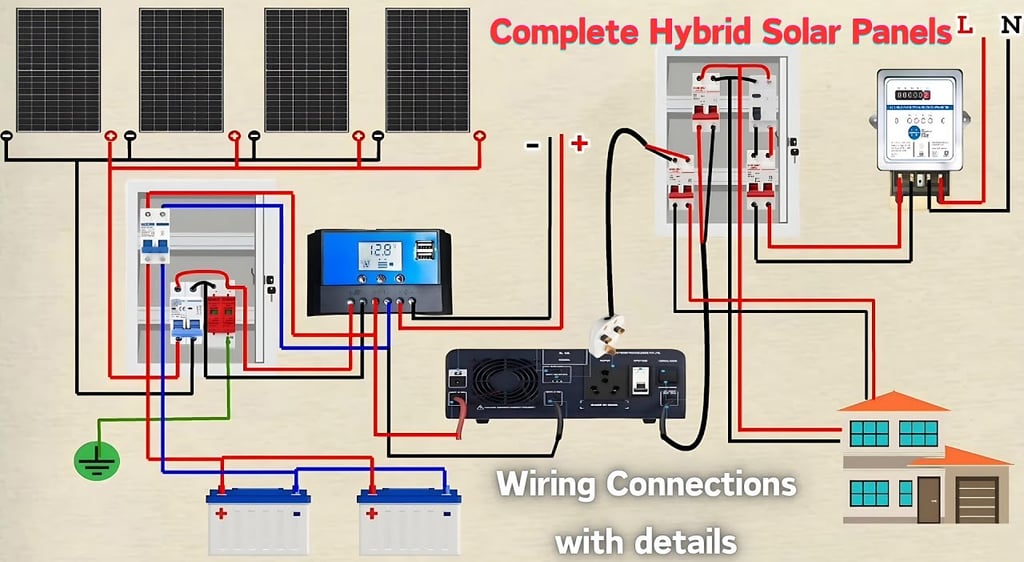
A hybrid solar system is an advanced energy solution that integrates solar panels, a battery storage bank, and a connection to the public utility grid. It functions as a "best of both worlds" middle ground between standard grid-tied systems (which lack backup) and off-grid systems (which are completely independent).
Core Components
Solar Panels: Capture sunlight and convert it into DC electricity.
Hybrid Inverter: The "brain" of the system that manages power flow between the panels, batteries, the grid, and your home loads.
Battery Storage: Stores excess solar energy generated during the day for use at night or during power outages.
Bidirectional Meter: Records electricity imported from and exported back to the grid for net metering.
How It Works
Daytime Usage: Solar panels power your home directly. Any surplus energy first goes to charging the batteries.
Exporting Surplus: Once batteries are full, any remaining excess power can be sent back to the grid for electricity credits (Net Metering).
Nighttime/Cloudy Days: The system draws from stored battery power. If the battery is depleted, it automatically switches to drawing power from the grid.
Grid Outages: Unlike standard grid-tied systems that shut down for safety, a hybrid system instantly switches to battery backup to keep essential appliances running.
Cost and Incentives in India (2025/26 Estimates)
The cost varies significantly based on system size and battery type (Lithium-ion vs. Lead-acid).
2 kW System: ~₹1.5 lakh – ₹3 lakh.
3 kW System: ~₹2.5 lakh – ₹4.5 lakh.
5 kW System: ~₹4 lakh – ₹7.5 lakh.
Subsidies: Under schemes like the PM Surya Ghar Muft Bijli Yojana, residential users can receive a flat subsidy of up to ₹78,000 for systems 3 kW and above. Note: Subsidies typically apply only to the solar portion, not the battery costs.
Cost and Incentives in India (2025/26 Estimates)
The cost varies significantly based on system size and battery type (Lithium-ion vs. Lead-acid).
2 kW System: ~₹1.5 lakh – ₹3 lakh.
3 kW System: ~₹2.5 lakh – ₹4.5 lakh.
5 kW System: ~₹4 lakh – ₹7.5 lakh.
Subsidies: Under schemes like the PM Surya Ghar Muft Bijli Yojana, residential users can receive a flat subsidy of up to ₹78,000 for systems 3 kW and above. Note: Subsidies typically apply only to the solar portion, not the battery costs.
Contact
Follow us on
© 2025. All rights reserved.
Connect
Reecard Industries Private Limited.
Beside Hotel JK Palace,
Pune- Nashik Highway, Vaki,
Chakan,Pune- 410501
Address
Mobile-
Email-
Website-
www.reecardindustries.com